Launch your first cybersecurity bundle in 30 days
A step-by-step plan to implement your cybersecurity solutions, streamline vendor management, and increase managed security services revenue.

Mike DePalma
March 12, 2026

I talk to MSP owners all the time who tell me, "I know I need to bundle cybersecurity solutions, but I don't know where to start."
They’re selling endpoint protection to one client, email security to another, and backup to a third. Each deal requires a unique sales motion. Each client gets a different stack of cybersecurity solutions.
This approach drains your operational efficiency. Your team juggles multiple vendor relationships, your techs context-switch between platforms, and your clients don't experience the full value because they're not getting complete protection.
I get it—MSPs are trying to meet clients where they are. But when every deal is a one-off, it puts you into a cycle that never scales. A standardized cybersecurity bundle breaks that cycle. It gives you a way to deliver complete protection, simplify vendor management, and grow recurring managed security services revenue without adding chaos.
Why a cybersecurity bundle beats à-la-carte options
First, let's talk about why you need to bundle at all.
Selling one-off security tools sounds easy—until you're managing 10 vendors, 10 portals, and 10 unique management workflows for every client. It doesn't scale.
When you sell cybersecurity solutions one at a time, you create three problems that compound over time:
- Your operational overhead explodes.
Every vendor means another relationship to manage, another billing cycle to track, and another support queue your team needs to monitor. You spend more time coordinating tools than protecting clients with integrated solutions. - Your margins shrink.
Clients compare your endpoint protection quote against three other MSPs selling the same product. You're forced to compete on price because you're selling commodities, not outcome-driven managed security services. - Your clients are less secure.
They think they're protected because they bought endpoint security . They don't realize their email remains vulnerable to phishing and malware, their backups are incomplete, and their users haven't been trained. Gaps exist everywhere, but nobody sees the full picture.
This structure creates blind spots that threat actors exploit. Your clients face real risk. And when something goes wrong, the conversation isn't about the one tool they didn't buy, it's about why their MSP didn't protect them. A comprehensive cybersecurity bundle closes those gaps.
Client buying behavior backs up this shift. Demand for comprehensive cybersecurity solutions increased more than 10% in 2024, with 27% of customers preferring to work with one vendor for security solutions. Clients want simplification. They want a partner who sees the entire landscape and manages it end to end.
When you bundle, you answer that demand directly. You consolidate vendor relationships, reduce friction, simplify vendor management, and position yourself as the single source of truth for security.
What a cybersecurity bundle solves for MSPs
Selling security bundles fundamentally changes your business model in three ways
- You shift from selling products to delivering outcomes.
Instead of quoting endpoint protection, you're selling defense against ransomware, malware, and data breaches. Instead of pitching standalone email security services, you're delivering protection against advanced phishing campaigns. Clients stop comparing features and start evaluating whether your cybersecurity bundle solves their risk. - You build predictable recurring revenue streams.
One-off sales create revenue spikes followed by dry spells. Managed security services generate consistent monthly income that compounds as you add clients. Cybersecurity is a top revenue driver for MSPs and those capturing that growth aren't selling licenses—they're delivering ongoing protection through bundle packages - You reduce complexity for everyone.
Your team manages one standardized stack instead of customizing solutions for every client. Your clients get one bill, one point of contact, and one security strategy. Simplicity scales. Customization doesn't.
The four-week framework to launch your cybersecurity bundle
Here's the good news about launching your bundles: you don't have to reinvent the wheel. You just need a solid, repeatable package you can deliver to your clients.
Here's a framework that works.
Week 1: Standardize your cybersecurity solutions stack
Pick the six core components every SMB client needs:
- Email security services to stop phishing and malware at the inbox.
- Endpoint detection and response (EDR) to identify and neutralize threats on devices.
- Cloud backup and recovery to ensure business continuity after an incident.
- Identity and access management to reduce credential misuse.
- Security awareness training to reduce human error.
- Monthly reporting and advisory services to prove value and surface improvements.
These components address foundational security needs. They cover the attack vectors responsible for most breaches: compromised email, unpatched endpoints, inadequate backups, stolen credentials, and user mistakes.
Your job is to select one platform that delivers integrated cybersecurity solutions while simplifying vendor management overhead. OpenText Cybersecurity for MSPs offers pre-integrated solutions across these areas, reducing the vendor management overhead that makes bundling complicated for many providers.
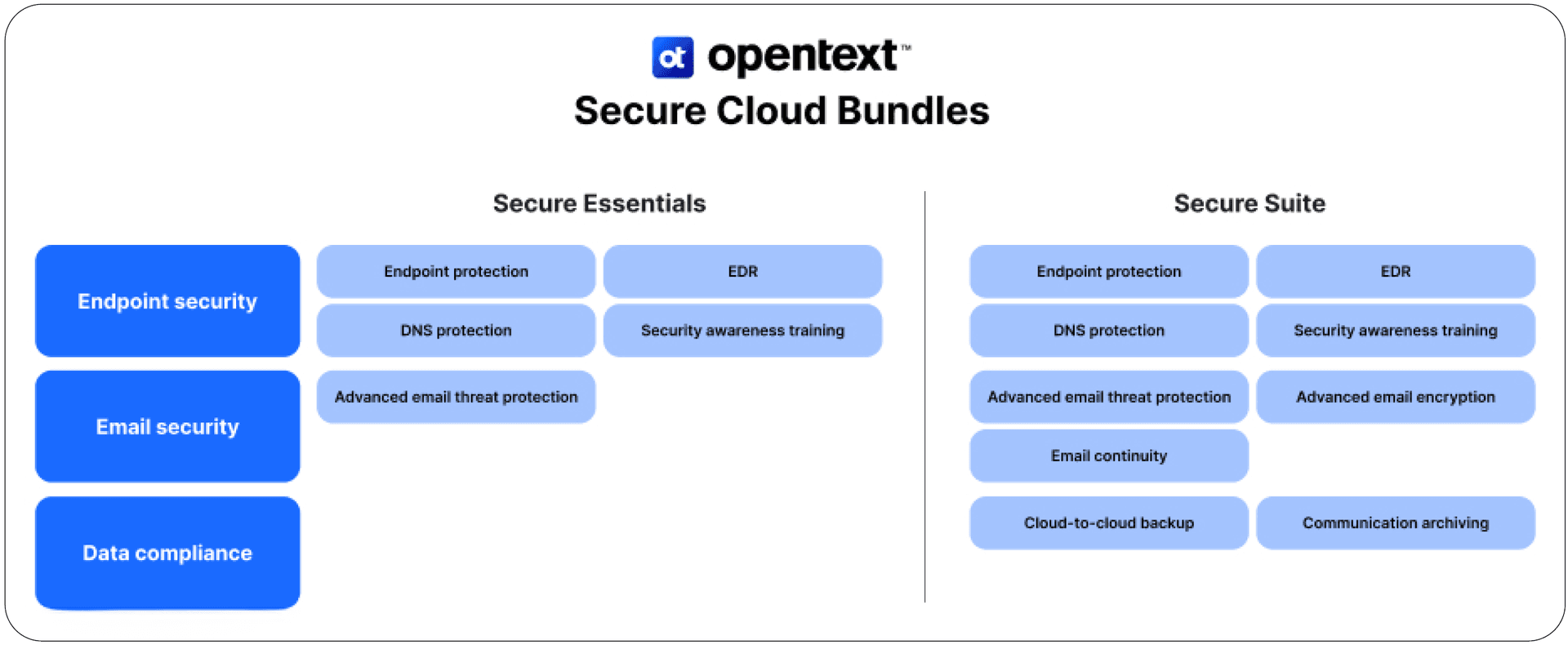
OpenText offers two pre-built bundle options that align with this framework:
Secure Essentials and Secure Suite.
Both bundles include endpoint security, email security, and data compliance capabilities with month-to-month licensing and no contract minimums. The Secure Suite adds enhanced encryption, email continuity, communication archiving, and expanded backup coverage. These pre-configured packages give you a tested starting point that you can deploy immediately rather than building from scratch.
Week 2: Build your value-based pricing model for your cybersecurity bundle
When MSPs price bundles based on license cost alone, they leave money—and margin—on the table.
Clients aren't buying software. They're buying managed security services that protect their business.
Price your bundle for outcomes.
Your monthly fee should cover:
- Licensing costs
- Management and monitoring
- Reporting
- Support
- User training
Don't be afraid to charge for the value you deliver.
If you need a benchmark, look at the OpenText Partner Ecosystem Multiplier (PEM) study:
OpenText partners who mature their offerings see a $6.73 revenue multiplier for every $1 of OpenText solutions their clients purchase. That multiplier comes from advisory work, implementation services, ongoing management, and the deep client relationships that emerge when you're responsible for protecting their entire business.
That's recurring revenue for MSPs at its best.
The economic case for bundling goes beyond multipliers. Managed security services represent a major revenue driver across the industry. When you price your bundle correctly, you tap into that growth. You shift from competing on individual product margins to capturing the full value of your expertise, service delivery, and ongoing relationship.
Week 3: Prepare your team for repeatable delivery
Your cybersecurity bundle is only valuable if your team can deliver it consistently. Spend this week building the operational foundation that will make your delivery scalable.
Make sure everyone knows what's in the bundle. They need to know the components and understand how they work together so that they can explain the value to your clients. If your support desk can't articulate why the bundle offers better protection than individual tools, you'll lose deals.
Standardize your deployment process. Document every step from initial assessment through launch. Build checklists. Create playbooks . Identify decision points. The goal is to turn deployment into a repeatable workflow that any trained technician can execute without improvisation.
Use vendor resources strategically. If you use OpenText Cybersecurity, you get access to cybersecurity partner program resources and onboarding.
Training also sets the foundation for future expansion of your security services. In fact, 95% of MSPs plan to expand managed service offerings, and 57% are actively developing new services. When your team has solid processes for your initial bundle, you can add new services without chaos. You build muscle memory around deployment, support, and client communication that scales as you grow.
Week 4: Launch your cybersecurity bundle to existing clients first
Now you're ready to sell. Your first launch doesn't need to be a big campaign.
Start with existing clients. Identify five to 10 existing clients who currently buy security products from you piecemeal. These are your ideal first customers because you already have a relationship and understand their environment.
Schedule strategy calls. Don't pitch—diagnose. Ask about their current security posture, recent incidents they've experienced, and gaps they're worried about. Listen for the pain points that your bundle can solve.
Present your bundle as the solution. Explain how the bundle addresses the problems they just described. Walk through the components. Show how they work together to eliminate gaps. Explain the value of having one partner managing their entire security strategy.
Keep the proposal simple. One monthly fee. Clear scope of services. Straightforward terms. Full-stack cybersecurity solutions under one managed agreement.
Offer migration support. If they're currently using different tools, explain how you'll transition them smoothly to your standardized stack. Minimize disruption. Make the change easy.
Use reporting to build trust from day one. Promise monthly reports that show threats blocked, vulnerabilities addressed, and security improvements made. Clients need visibility into the value they're paying for. Regular reporting keeps them engaged and justifies renewal.
Pro tips for success with your cybersecurity bundle
The MSPs that see results fastest don’t try to do everything at once. They focus on repeatable systems and clear outcomes. Here are some of the most effective practices I’ve seen drive early success:
- Don’t over-customize. Standardize your bundle so it’s repeatable and easy to scale.
- Lead with outcomes. Sell protection, productivity, and peace of mind—not a list of features.
- Show your impact. Use monthly reports to highlight results and justify the value of your service.
- Rely on your vendor. The right partner should lighten your load. OpenText Cybersecurity’s MSP suite integrates with Microsoft 365 and provides strong sales and technical support.
One more thing: listen to what clients value. Cost isn’t always the deciding factor:
44% of SMBs rank the strength of security solutions as the top factor in purchasing decisions.
That’s an important indicator: clients want proven protection more than the lowest price. This gives you room to price for value and lead with quality.
Why you should start now
I see MSPs hold off because they want everything to be perfect. Don’t wait for perfect.
Launching your first cybersecurity bundle doesn’t require a huge investment. It takes focus, structure, and a 30-day plan. The sooner you standardize, price, train, and launch, the faster you’ll see:
- Less operational chaos
- Happier clients
- Steady, high-margin recurring revenue
The timing couldn’t be better for MSPs. Global information security spending is projected to hit $213 billion in 2025. That growth reflects rising threat awareness, cloud adoption, and the cybersecurity talent gap pushing businesses toward MSPs.
Launch now, and you’ll be positioned to capture that demand before your competitors do.
Final thoughts on building scalable cybersecurity solutions
Cybersecurity isn't going away. It's getting more complex, and clients can’t—and don’t want to—manage it alone.
That's your opportunity.
By packaging your expertise into a managed service, you move from reactive IT support to trusted cybersecurity partner.
You make your revenue predictable, your delivery scalable, and you make your business far more valuable.
If you've been following our blog series on MSP revenue multipliers, you know that expert MSPs earn up to 18x more revenue than their competitors by positioning themselves as strategic advisors rather than product resellers. Bundling is one of the clearest paths to that level of performance.
When you deliver comprehensive, managed security services, you deepen client relationships, increase lifetime value, and build the recurring revenue foundation that separates top-performing MSPs from everyone else.
If you want a closer look at OpenText’s MSP security bundles or more information on our MSP program, contact us now.

OpenText Partner Ecosystem Multiplier (PEM) Study
Based on real MSP partner data, discover how you can move beyond resale and build a high-margin, recurring revenue business.

Mike DePalma
Mike DePalma is vice president of SMB business development for OpenText Cybersecurity.